Press Note
Serbia,Nepal, Malaysia, Mexico
Morocco, Madagascar
Source by :- Bloomberg news hub
26 December 2025, 10:30 AM
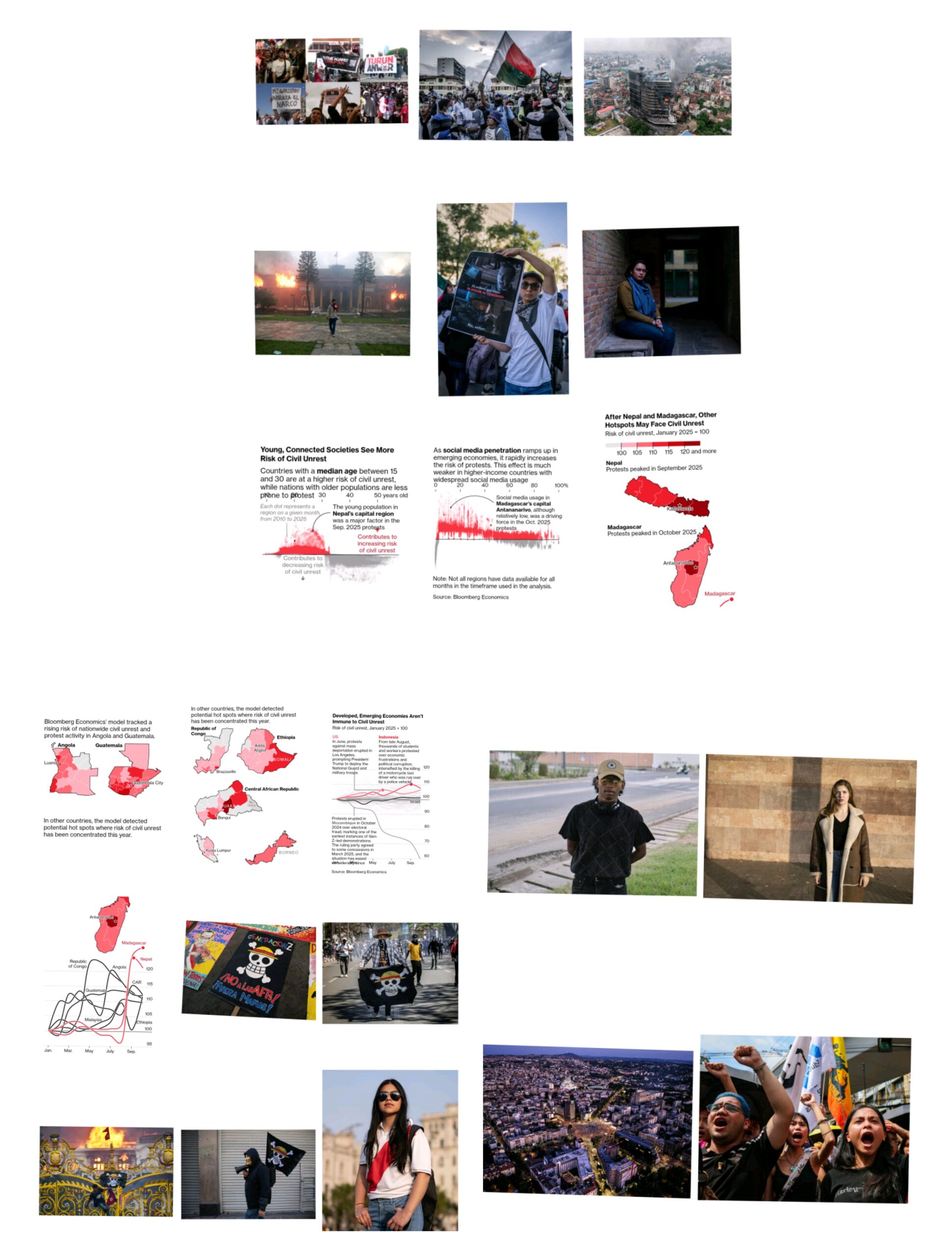
Gen-z protests around the globe from Serbia, clockwise from top left, Nepal, Malaysia, Mexico, Morocco, and Madagascar. Video: Getty Images
The Big Take
Gen-Z Revolts Against Dystopian Future as Protests Sweep the Globe
Mass movements have ousted leaders and disrupted governments worldwide. Bloomberg Economics examines what countries may face unrest in 2026
By Philip Heijmans, Martin Quick, Gonzalo Soto, Dan Strumpf, Souhail Karam, Marcelo Rochabrun, Misha Savic, Tom Fevrier and L. Eric Rakotonirina
Crushed by soaring rents and living costs and staring down a future where robots and AI threaten their jobs, Gen Z is unleashing a wave of protests that is rattling governments worldwide.
Leaders have already fallen in Nepal, Madagascar and Bulgaria, while administrations from Indonesia to Peru and Serbia grapple with relentless youth-driven unrest that’s fomented on social media and draws inspiration from video games and anime. It’s a frustration echoed even in advanced economies, where Zohran Mamdani’s surprise mayoral win in New York City underscored how deeply affordability concerns and economic anxiety are shaping the politics of the youngest working generation.
While the sparks differ by country, interviews with protesters, sympathizers and experts reveal shared grievances: frustration over rising inequality, underemployment, corruption and a deepening doubt among students and young workers that they’ll ever enjoy the kind of lives their parents had. The Carnegie Protest Tracker tallies 53 demonstrations of 10,000 people or more across 33 economies this year, the highest total since the project began in 2017.
Protesters celebrate after an address from members of a section of the Malagasy army following clashes between demonstrators and security forces during protests calling for the resignation of President Andry Rajoelina in Antananarivo, on Oct. 11. Photographer: Luis Tato/AFP/Getty Images
To understand what’s driving the angst in some of the global hot spots, Bloomberg Economics fed a machine learning model 22 million data points across metrics ranging from political polarization to income inequality and from oil prices to population age structures. The findings suggest that — from Nepal to Madagascar and Peru to Morocco — social media penetration and a low median age increase the risk of discontent over issues such as inequality, unemployment and corruption tipping over into high levels of civil unrest.
Among the estimated 17,000 Gen-Z protesters marching through Mexico City on Nov. 15, 20-year-old student Alexander Alvarado held aloft a poster of Master Chief, a character from the Halo video-game franchise, refusing to obey orders he believes are wrong.
“That inspired me to come, to defy what I think is not OK with this country,” said Alvarado, who wonders how he’ll ever afford to move away from his family home. He learned of the protest plans on Discord, then began reading about similar movements in Spain and Argentina and Gen-Z marches in Nepal that toppled the government there.
Alexander Alvarez, a student in Mexico City, holds up a poster of Master Chief, the central character from the Halo video game series. Photographer: Marian Carrasquero/Bloomberg
Amrita Ban was on the streets of Kathmandu in September. Years of bottled up frustration at a lack of decent job opportunities that had spurred her elder siblings to head abroad for work — all while watching the children of politically-connected parents live luxurious lives — came to a head when the government introduced a social media ban in what appeared to many as an attempt to muffle dissent.
“It served as a trigger,” said 23-year-old Ban, who’s juggling her studies with work as a freelance event organizer and translator. “They are trying to silence our voice. They don’t want to hear it. So this is it: the street is the way.”
That week in early September, Nepali security forces brutally cracked down on the protesters, who set fire to government buildings and stormed parliament. The homes of top officials, including the prime minister’s residence, were burned down, along with the five-star Kathmandu Hilton, which opened last year. But the demonstrators did something few thought possible: they brought down the government. Prime Minister KP Sharma Oli resigned on Sept. 8.
As in earlier Gen-Z protests in Indonesia, a version of the Jolly Roger Pirate flag from the 1997 Japanese manga series One Piece was adopted as a symbol by protesters. After the bloodshed, the army invited protest leaders for talks on who should lead an interim government. They held a straw poll on Discord, choosing Sushila Karki, a tough 73-year-old former Supreme Court justice, who was soon sworn in as the country’s first female leader and has been working with protest leaders to ensure their concerns are heard. Elections are scheduled for March 5.
Amrita Ban, a 23-year-old student, in Lalitpur, Nepal. Photographer: Uma Bista/Bloomberg
A demonstrator draped in the Nepal national flag stands in front of the president’s office as a fire rages during a protest in Kathmandu, in September. Photographer: Prabin Ranabhat/AFP/Getty Images
Smoke billows from the burning Hilton Hotel, a day after it was set ablaze by protesters in Kathmandu. Photographer: Prabin Ranabhat/AFP/Getty Images
Bloomberg Economics’ model flags income inequality as a key driver of unrest in Peru and Mexico — among the world’s most unequal nations — while political corruption ranks among the top triggers in the Philippines. In Madagascar’s case, it’s poverty that makes it vulnerable to unrest: World Bank data show roughly two-thirds of its population lives on less than $3 a day, and limited access to basic services like clean water and sanitation has become a major flashpoint for protests.
Looking ahead to 2026, Bloomberg Economics’ model flags Ethiopia, the Central African Republic, Angola, Guatemala, the Republic of Congo and Malaysia as countries at heightened risk of civil unrest. Among the 157 nations tracked, these six have seen the fastest rise in unrest risk since January, behind only Nepal and Madagascar.
Indeed, Malaysian Prime Minister Anwar Ibrahim faces mounting risks from rising Islamism and fractures within his coalition, issues compounded by public frustration over economic issues. Recent setbacks at the polls have meanwhile been interpreted as a sign of declining public confidence, with Anwar himself appearing to acknowledge the youth risk.
“The recent wave of Gen Z protests in several countries has made it clear that the will of the youth is no longer insignificant and that their prioritization of good governance has increased,” he said last month. “Society should harness their energy.”
Overall, advanced economies and major emerging markets are less prone to serious civil unrest. Yet a few — notably the US, Indonesia, and Israel — rank among the countries most at risk of protests, with unrest risk climbing since the start of the year.
A separate youth misery gauge developed by Bloomberg Economics that combines youth unemployment with five-year average inflation shows economic hardship for young people rising across much of the world. A triple-digit rise in inflation in Zimbabwe, at 152%, and Argentina, at 103%, put the two countries at the top globally, followed by nations like Turkey, Suriname, Iran and Angola, all hit by sustained double-digit price growth.
Even as prices rise, the world’s youngest working generation faces a historic jobs squeeze. The International Labour Organization reports that about one in four young people worldwide are neither employed nor in education or training — a rate that remains stubbornly high in many low- and middle-income nations struggling with inflation and cost-of-living pressures. As a result, workers are drifting into low-productivity services jobs — a shift that’s contributing to rising political fragmentation as growing discontent fuels increasing demands for structural change.
The Jolly Roger pirate flag has emerged as a symbol of global Gen-Z protests, appearing in places such as Madagascar, Peru, Nepal, and Mexico. Photographer: Luis Tato/AFP/Getty Images , from left, Angela Ponce/Bloomberg, Sunil Pradhan/Anadolu/Getty Images, Daniel Cardenas/Anadolu/Getty Images
“Democracy seems to be in some sort of a crisis around the world, from the Philippines to Brazil, from the US to France,” said Daron Acemoglu, an economist at the Massachusetts Institute of Technology who won the Nobel Prize for economics in 2024. “It is not unrelated, and younger people are the spearhead of that crisis.”
At the same time, AI disruption and rising living costs are roiling wealthier economies, creating a politics of affordability that mirrors the anger now taking shape in emerging markets — a dynamic illustrated by Mamdani’s victory last month.
“My hope is that liberal democracy will rise up to the challenge and articulate a feasible, aspiring, and more just solution to some of these problems,” said Acemoglu, who wrote the 2012 book Why Nations Fail. “Unless that happens, I think this will continue, and in some places, it will turn into a rupture with democratic institutions or the support for them completely collapsing.”
As youth protests ripple around the world, one of the latest flashpoints is in Peru, where Gen-Z demonstrators helped spur the ouster in October of then President Dina Boluarte, who was deeply unpopular due to her failure to rein in rising crime rates. Now, her successor is facing ongoing unrest.
“I’ve seen what happened in Nepal and other parts of Europe and many people see it as an example to follow,” Angelina Chávez, 17, said at a protest in Peru’s capital Lima in November against new president Jose Jeri. Her top concern, which spans generations, is crime. “We want safety, we want the government to provide what it should provide,” she added.
Angelina Chávez during a Gen-Z protest in Lima. Photographer: Angela Ponce/Bloomberg
This fall in Madagascar, young people took to the streets for weeks to rail against water and power cuts and the general state of one of the world’s poorest countries. Security forces cracked down on protesters severely before President Andry Rajoelina sacked his entire government — by mid-October he was overthrown by soldiers and fled the country.
Miora Rasoanirina, a 22-year-old delivery rider for an e-commerce company, was among those who took to the streets “because working hard is no longer enough to live decently.” She contrasted her life with older generations: “My mother worked in a textile company, with a modest but steady salary, but I don’t have stability,” she said. “Everything depends on the number of orders I get, and on weather conditions.”
“Delivery workers in Europe, Latin America or Kenya face the same issues,” she said. “We’re part of a generation that works a lot but stays poor.”
Another protester, Nelly Razafimamonjy, also compared his lot with his parents.
“At my age, my father already had a fixed public service job, while I keep going from one temporary contract to the next. I have no security, no social benefits,” said the 24-year-old law graduate, who doesn’t have steady work. “I feel connected to them — young people in North Africa, France, or Senegal are protesting for the same reasons: precarity, lack of opportunities, rising cost of living.”
Nelly Razafimamonjy Photographer: iAko M. Randrianarivelo/Bloomberg
About 8,000 kilometers (5,000 miles) away, 24-year-old lab technician Oussama shares many of those frustrations. Youth protests in Morocco in September over public healthcare, education and alleged corruption resonated deeply, though he stayed home for fear of arrest and losing his job.
“My parents worked hard for the ‘Moroccan dream’,” he says, using air quotes to describe their building a home and raising a family of three children. “Only a radical change can allow me to replicate their success.”
In Serbia, Gen Z has been at the forefront of a widespread anti-government movement for more than a year. Massive anti-government rallies began late last year after a roof collapse at a railway station killed 16 people, triggering accusations of corruption and incompetence on the part of the authorities. The almost daily rallies have snowballed into the biggest challenge for strongman President Aleksandar Vucic.
Students from state-funded universities in the country have emerged as a political force in their own right. Their informal, ad-hoc groups on campuses managed to mobilize masses, tapping the long-simmering discontent, which the established opposition groups were unable to do. They’ve taken up other causes as well, including against a controversial project to build a Trump Tower in central Belgrade, a hotel and luxury residence planned by affiliates of Jared Kushner, Donald Trump’s son-in-law.
Protesters gather in central Belgrade demanding that the government call early elections after months of student-led strikes, in June. Photographer: Djordje Kostic/AFP/Getty Images
“We’re going all the way in this fight — we won’t back down,’’ said Valentina Moravcevic, 22, who studies applied arts at the University of Belgrade, at a Nov. 20 rally against the real estate project.
This month, Kushner’s private equity firm, Affinity Partners, dropped its plans for the hotel. “Because meaningful projects should unite rather than divide, and out of respect for the people of Serbia and the City of Belgrade, we are withdrawing our application and stepping aside at this time,” an Affinity spokesperson said in a statement.
Valentina Moravcevic Photographer: Igor Pavicevic/Bloomberg
In neighboring Bulgaria, Prime Minister Rosen Zhelyazkov stepped down on Dec. 11 after a wave of protests triggered by a government plan to increase spending in next year’s budget that many protesters believe would only help corrupt politicians strengthen their grip over the country’s institutions. The crisis underscores a growing sense of resentment, especially among younger Bulgarians, that corruption has flourished despite years of EU membership meant to bolster the rule of law.
Still, in many countries, the broad populace remain skeptical of what to expect from young activists who are mostly in their early twenties. For some, there are echoes of the Arab Spring, where revolutions that toppled authoritarians and the status quo ended in heartbreak across the Middle East.
“I think particularly problematic issue in many of these sort of protest movements is that they lead to some promises of radical policies, but they’re not sustainable, they’re not realistic,” said Nobel-laureate Acemoglu. “So to the extent that they are perceived as solutions coming out from the liberal democratic system, they further tarnish that system because none of the promises turn to reality.”
Demonstrators during protests against government corruption in Manila, in October. Photographer: Daniel Ceng/Anadolu/Getty Images
Gen-Z frustration in the Philippines has become a powerful accelerant inside a broader national protest movement pressuring President Ferdinand Marcos Jr. to confront alleged corruption, rising prices and the shortage of stable, well-paying jobs. In a country dominated by a small circle of affluent political families, where students rank among the world’s weakest in math, reading and science, young Filipinos see a system that limits their ability to catch up and compete.
That economic unease is sharpening as the country’s service-led economic model faces technological disruption. The Philippines, long a major exporter of back-office services, is now one of the most AI-exposed economies in the region, with around one-third of jobs at risk of displacement, according to the IMF. Many of these roles are held by young workers already clustered in low-productivity roles — and they’re mobilizing to ensure the government hears them.
“We have weekly noise barrages and weekly walkouts in the schools,” said Howard Calleja, a spokesman for the protest movement. “It keeps the flame burning.”
Youth unemployment in emerging Asia is a macro risk, not just a social one.
“Persistently elevated unemployment spells are a macro problem because they reduce skillsets and cause individuals to become disconnected from the workforce,” Krishna Srinivasan, director of the IMF Asia and Pacific Department said in October. “The damage is especially acute for young people: early setbacks can shadow their careers for years, leaving a lasting dent in the country’s human capital.”
Among the thousands who hurled stones and set off firecrackers in Indonesia’s capital Jakarta in August to protest rising living costs and elite capture, many wore the signature green jackets and helmets of ride-hailing platforms — a stark reminder of an informal economy where one in seven young Indonesians is unemployed. Others flew the One Piece pirate flag.
In Kathmandu, protester Ban and other leaders have founded a group called the Nepal Gen-Z Front, a body that’s seeking to unify the movement of Gen-Zers that ousted the former government. She’s the head of the campaign department, charged with registering young voters for the upcoming election. In a sign of the challenge ahead, tens of thousands took to the streets on Dec. 13 in support of the party of ousted prime minister Oli, who told supporters the dissolution of parliament was unconstitutional and was re-elected to lead his party last week.
“If we don’t work properly to get fresh faces in the parliament, this could all be in vain,” Ban said. “For now, we have no other option rather than hoping for the best and putting our support in government and raising questions when it’s getting off the track.”
Methodology
Bloomberg Economics trained a random forest regressor to predict the intensity of civil unrest in the next twelve months at the level of subnational regions. The model is trained on over 50 indicators that range from the strength of a country’s political institutions to the ethnic and demographic composition of a region’s population, and from macroeconomic indicators like inflation, unemployment and growth to the recent history of unrest in the same or neighboring regions. The intensity of civil unrest is estimated using data on protests and riots from the Armed Conflict Location & Event Data (ACLED) project.
A random forest is a supervised machine learning model that trains several decision trees on randomly selected subsets of its training data and makes predictions using an average of the predictions of the decision trees in the ensemble. Index scores are then constructed by rescaling the model’s predictions to a range of 0-100, where higher scores indicate a higher risk of civil unrest. Subnational scores are also aggregated to produce country-level scores. All country scores and their drivers can be found on the Bloomberg Terminal at BECO MODELS DASHBOARDS.
The misery index — originally stipulated by Arthur Okun in the 1970s as an indicator of economic hardship — is constructed by adding the unemployment rate to the inflation rate. Extrapolating from this framework, Bloomberg Economics’ youth-targeted misery index includes the youth unemployment rate instead of the national jobless measure. The index also references inflation over the recent five-year period — rather than a single year. That reduces volatility and base effect distortions, while still capturing cross-country differences in the run-up in the cost of living.
RNI:- MPBIL/25/A1465
Devashish Tokekar
VANDE Bharat live tv news Nagpur
Editor/Reporter/Journalist
Indian Council of press,Nagpur
Journalist Cell
All India Media Association
Nagpur District President
Delhi Crime Press
AD.Associate /Reporter
Contact no.
9422428110/9146095536
Head office:- plot no 18/19, flat no. 201,Harmony emporise, Payal -pallavi society new Manish Nagar somalwada nagpur – 440015